

Portfolio Update #4: Dodging A Bullet At A Profit
Exiting All Positions At a ~40% Overall Return In Anticipation Of A Large Market Crash

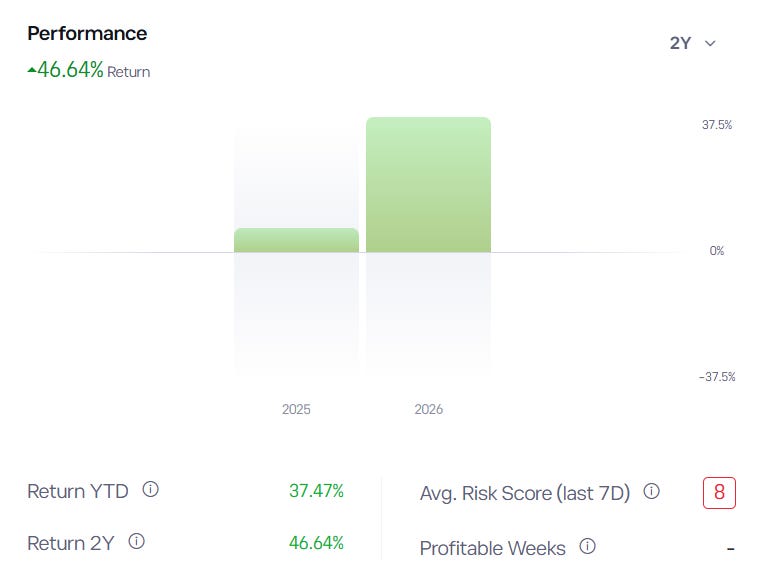
As explained in Portfolio Update #1, Connection Capital believes that we are in the late stages of the liquidity / economic / business [enter your preferred cycle] cycle. To refresh your memory, the late stages of the cycle are where smaller, more speculative assets often outperform. This is where Connection Capital has focused its allocations over the last 3-4 months, and it seems this final stage of the cycle is close to being over.
Given this fact, Connection Capital has made the difficult decision of exiting from all positions at an overall profit of around 40%. At its peak, the Connection Capital portfolio had nearly doubled. In retrospect, many of the rotations between sectors forecast in the first portfolio update occurred much faster than expected. In fact, they occurred so quickly that for all intents and purposes, all assets rallied together.
This tendency for speculative assets from different sectors to move together was taken as further evidence that we are in a late cycle environment, and contributed to the decision to liquidate the portfolio. However, the primary contributor was the forecast for the US dollar as measured by the DXY, which is pictured below. As you may have seen, the DXY recently hit 99.5 and appears to be rising - a bad sign for the markets.
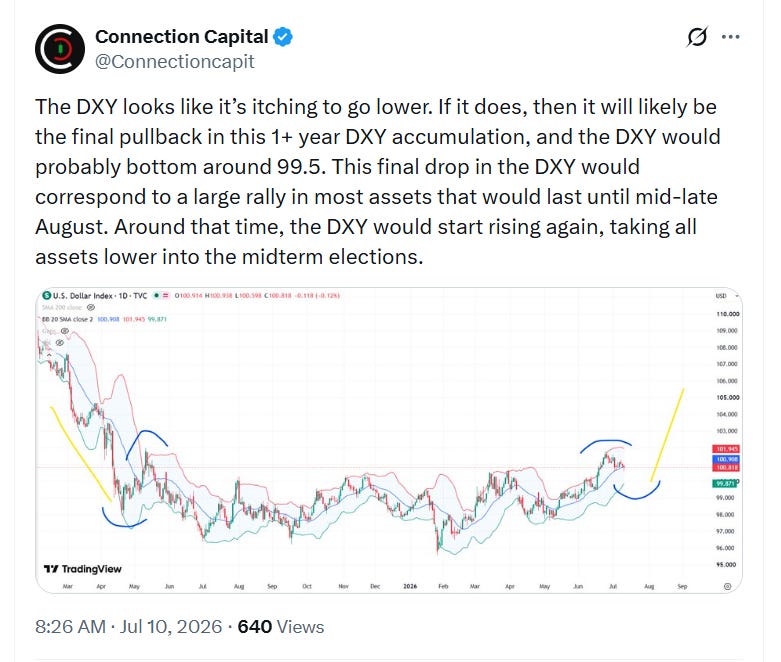
As you may know, when the US dollar goes higher, everything else tends to go lower. The reason why the US dollar has been rising recently looks to be primarily due to rising oil prices which are likely to keep climbing given the continued closure of the Strait of Hormuz by both Iran and the US. This rise in energy prices is putting pressure on the Euro and the Japanese yen, which has been pushing the DXY higher.
Like many other speculators, Connection Capital believes that once the markets start falling as a result of the rising US dollar (and rising bond yields globally), there is likely to be a crisis of some kind that justifies intervention and stimulus. As explained in Alpha #4, Connection Capital believes this crisis would likely be a natural disaster, most likely a big earthquake that disrupts the Asia Pacific or US/Canadian West coast.
To be clear, Connection Capital is not betting on a big earthquake occurring. But it is betting that something will eventually break. Once this breakage occurs and the stimulus inevitably floods the markets, Connection Capital will either re-allocate to the assets it previously held at a discount or allocate heavily into TLT as explained here. This ultimately depends on the nature of the breakage and the intervention.
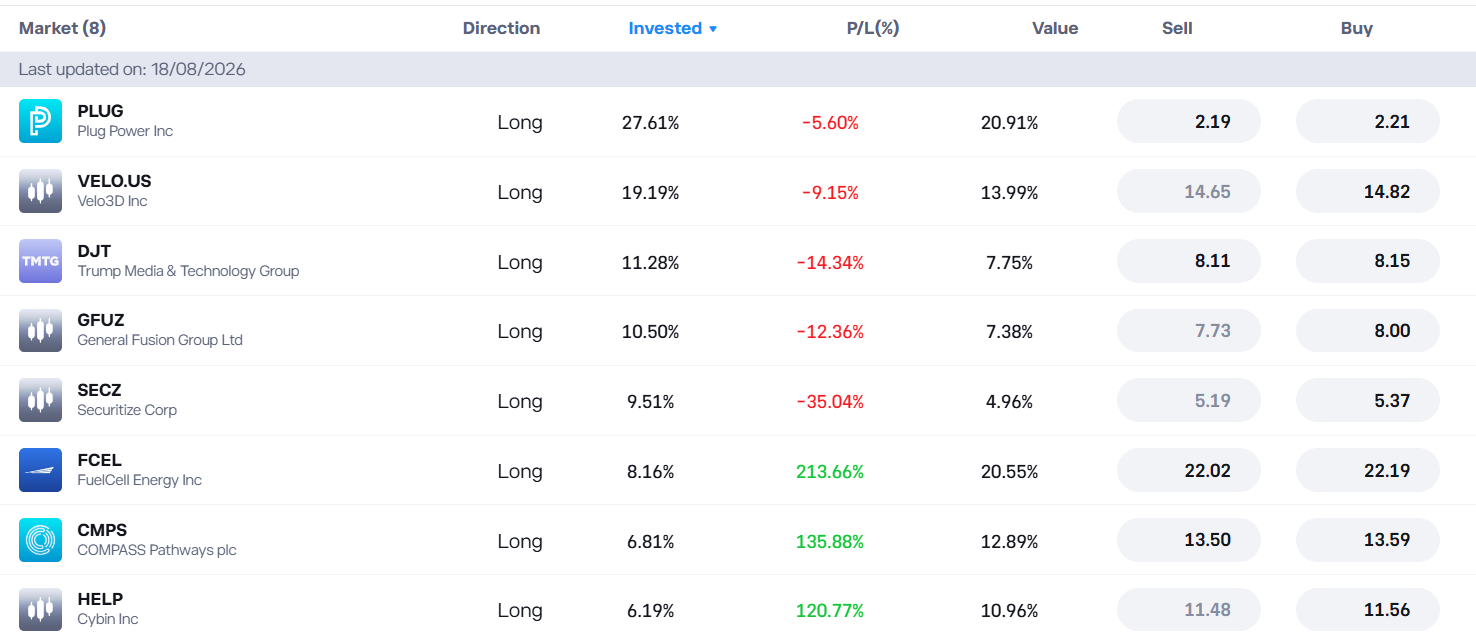
For the sake of transparency (and for Connection Capital’s own reference) the composition of the Connection Capital portfolio prior to liquidation as well as the associated profit or loss of each stock is pictured above. As noted earlier, the most profitable time to exit would have been back in June, close to the time that the first portfolio update had been posted. As always, timing is the hardest thing to get right.
For what it’s worth, almost all the assets identified by Connection Capital experienced significant rallies after their identification: PLUG nearly doubled, as did VELO (in 48 hours!). FCEL also more then doubled from the time of mention, and all the psychedelic stocks did too (and actually kept their gains!). With more optimal timing, the Connection Capital portfolio would in fact have been around 2x overall.
Funnily enough, allocating to TLT or other long bonds in the coming months should yield similarly sized returns to the final Connection Capital portfolio (~30-40%). As such, this is likely to be the next large allocation that Connection Capital makes, but it is worth reiterating that the decision to make this allocation depends on the type of breakage and the resulting intervention which has yet to occur at the time of writing.
Disclaimer
The information provided in this article is for informational purposes only and should not be construed as financial, legal, or tax advice. The views expressed herein are solely the opinions of the author, who is not a licensed financial advisor or registered investment advisor.
Speculating in stocks and/or cryptocurrencies involves a significant risk of loss. The author does not guarantee any specific results or outcomes. Readers should conduct their own research or consult with a professional before making any investment decisions.